
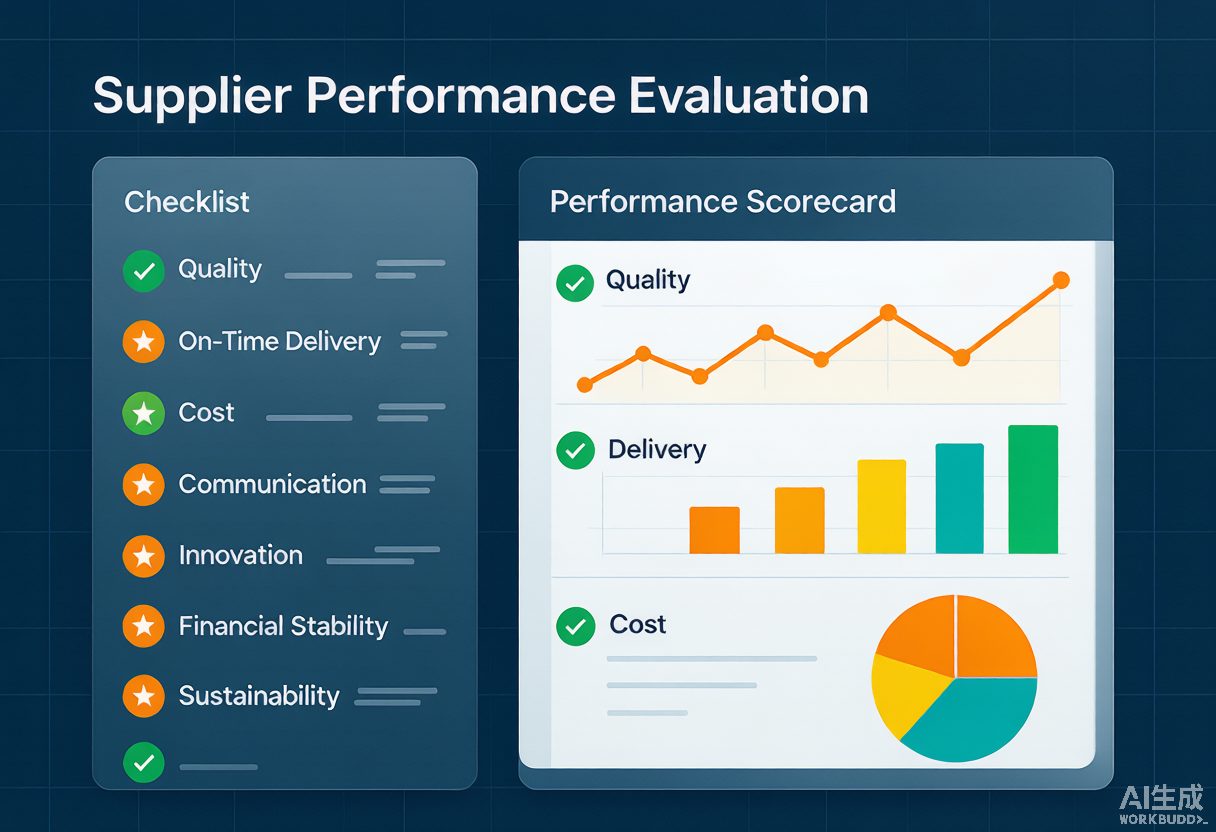
Every purchasing department claims to evaluate suppliers. Few do it systematically. A well-designed supplier scorecard converts opinions into numbers you can act on — and defend. Here is how to build one.
Why a Scorecard Matters
Without a standardized evaluation, decisions get made on gut feeling and recent memory. Scorecards create a consistent framework, enable apples-to-apples comparison, and provide evidence when you need to switch suppliers or renegotiate terms.
Step 1: Define the Scorecard Dimensions
Most B2B organizations evaluate on four pillars: Quality (defect rates, compliance), Delivery (on-time performance, lead time stability), Cost (unit price, total cost trends), and Service (responsiveness, problem resolution). Weight each dimension to reflect your priorities.
Step 2: Select Measurable KPIs
Each dimension needs objective metrics. For quality, track parts-per-million defects and audit scores. For delivery, measure on-time-in-full percentage. For cost, monitor price variance and landed cost per unit. Choose metrics you can actually collect reliably.
Step 3: Assign Scoring Scales
Use a consistent 1-5 or 0-100 scale with written definitions for each level. A score of 3 should mean the same thing to every evaluator. Document the scale and train your team to apply it consistently.
Step 4: Collect Data Automatically
Manual scorecard maintenance fails quickly. Pull quality and delivery data from your ERP, connect supplier performance databases, and automate monthly scoring where possible. Data quality is the foundation of scorecard credibility.
Step 5: Review at Regular Intervals
Run supplier reviews quarterly and deep reviews annually. Scorecard trends matter more than single-period scores — a supplier trending downward needs intervention before problems surface in your operations.
Step 6: Act on the Results
Share scorecards with suppliers. Top performers should receive preferential treatment — larger orders, longer contracts. Underperformers need improvement plans with clear targets and review dates. Rewarding good performance is what makes the system work.
Common Pitfalls to Avoid
Avoid over-engineering the scorecard with too many metrics, using data you cannot verify, or ignoring the service dimension because it is harder to measure. Start simple, prove the value, then expand.